Fish species you can catch in Aegean

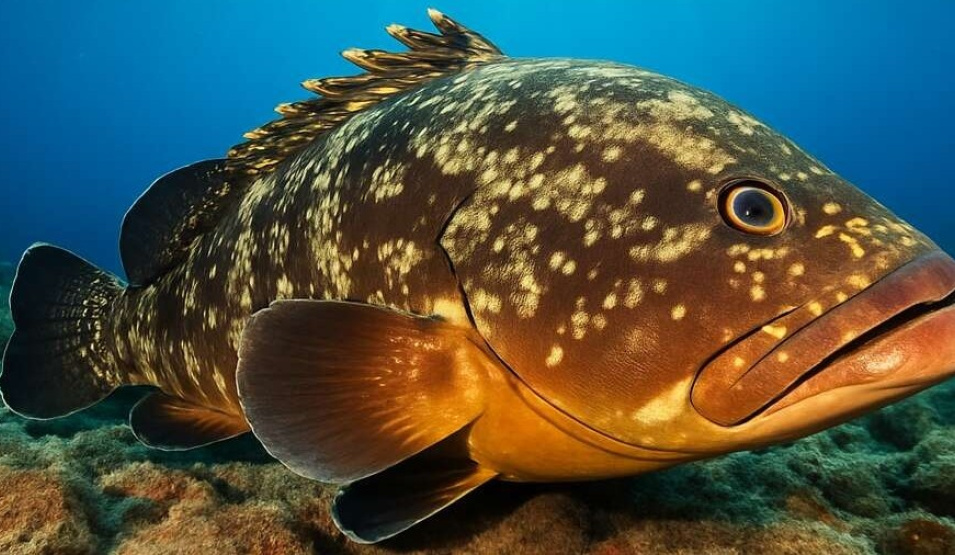
Dusky grouper
Epinephelus marginatus
The most common Mediterranean grouper, the biggest fish of the rocky coasts. Its color is dark brown to black with yellow spots. It lives in rocky bottoms and caves at depths from 5 to 300 meters. Big groupers are solitary, they hunt on their own territory and spend a lot of time in front of their shelters. It is protogynous hermaphrodite, which means that it starts its adult life as a female and then begins to breed at the age of 5. The fish start to transform from female to male at the age of 12 when it has reached the size of about 65 cm. The dusky grouper can live 50 years and its weight can reach up to 60 kg.
Golden grouper
Epinephelus costae
The golden grouper is bicolore fish in a way that had led to believe that male, female and juveniles are different species. Juveniles are brown with darker stripes on the side. It gets darker as it grows. Males are dark brown on the back with white on the belly and a striking yellow mark on the side. Females are dark brown-orange with horizontal lines. It loves relatively warm waters and rocky bottoms, but can also be found on sandy bottoms with vegetation at depths of 20 to 80 meters. They form small groups and feed on cephalopods, crustaceans and fish.

White grouper
Epinephelus aeneus
The white grouper is found mainly in the southern and eastern Mediterranean. It can easily be recognized by the 6-8 broad dark vertical bands on its pale body. This pattern is more pronounced in young individuals. It is a powerful and voracious predator. It spends most of the day resting in caves and crevices near sandy bottoms and becomes much more active while hunting. Its diet consists of fish, cephalopods and crustaceans. The white grouper has large, strong and sharp teeth. Once it catches its prey, there is almost no chance for it to escape. This species is a protogynous hermaphrodite: individuals first mature as females at 5-7 years of age (about 50 – 60 cm long), and later change sex to males when they are 10 – 13 years old (approximately 80 – 110 cm long).
Wreckfish
Polyprion americanus
The wreckfish is one of the largest fish species found relatively frequently in our seas. Its back is dark brown or grey, while its belly is lighter in color. It can grow up to 2 meters in length and weigh as much as 100 kilogramms. It is a solitary species that prefers to live in caves and on rocky seabeds at depths between 40 and 200 metres. It feeds on other fish and cephalopods, which it swallows with its enormous mouth. Juveniles live near the sea surface and often gather beneath floating objects, where they can hide and feed successfully.
Red scorpionfish
Scorpaena scrofa
The red scorpionfish is the largest species of Mediterranean scorpion. Its color is red-orange or brown with dark scattered spots all over the body. The color varies and depends on the environment it lives from seaweed bed to rocky bottoms. On the lower jaw there are various skin protrusions that wave in the currents like seaweed, offering the scorpionfish the perfect camouflage. So even fishermen sometimes make a mistake and take it for a stone. In addition to excellent camouflage, it has an extra weapon for defence. This is the spines on the dorsal fin and head that have strong venom and cause severe pain and numbness in the area they will pierce.
Black seabream
Spondyliosoma cantharus
The black seabream is easily recognized by its oval-shaped body. It has silvery to dark grey coloration with blue and pink hues, crossed by broken longitudinal golden stripes. It lives in schools close to the seabed at depths ranging from 5 to 300 metres. Its diet consists of algae, crustaceans and other invertebrates. The black seabream is a protogynous hermaphrodite, meaning that individuals begin life as females and later change into males – a phenomenon that is fairly common among fish. A particularly interesting feature of this species is its breeding behaviour. During the summer, the female lays her eggs in a shallow nest that has been excavated in the sand, while the male guards the nest for about nine days, until the eggs hatch.
Stingray
Dasyatis Pastinaca
The stingray is a predator with the elegance of a butterfly. When it spreads its wings, it moves majestically in the water but it can also lurk in the sand. Lying in wait, only two eyes emerge. As a crustacean, a mollusc or a fish approaches, it launches upon it with the help of its large fins. Its long tail is equipped with a venomous spine which can measure as long as 35 cm. This spine is fearsome , and might inflict serious wounds including local paralysis to human. The sting ray is ovoviviparous, which means that it has internal fertilization and produces 4 to 7 eggs that develop within the maternal body and hatch after 4 months.
White seabream
Diplodus sargus
The white seabream is one of the most famous fish in our waters, because of its taste. Its color is grey with silver, blue and green shades. It has 8 to 9 dark vertical stripes on its sides. It shows a black spot at the base of the tail and a strong black shade at the end of the tail. It is a hermaphrodite fish, which starts as a male and when it reaches a weight of about 300 grams it becomes a female. It usually lives in bottoms, full of rocks that form cracks, holes and pits at depths of up to 50 meters. It feeds on molluscs and small fishes.
Red porgy
Pagrus pagrus
The red porgy is characterized by a soft pink coloration and small vague yellow spots in various points on its body. Sometimes in young individuals, fine blue dots present on upper sides of the body. It is found on sandy bottoms but also on rocky areas down to even 250 meters depth. It feeds upon small fishes, crustaceans and molluscs. It is usually protogynous hermaphrodite as not all fish change sex. There is some evidence that the timing of the sex change is linked to environmental factors.
European seabass
Dicentrarchus labrax
Dark back and white belly, the European seabass goes unnoticed near the surface. It is euryhaline and eurytherm species, meaning that it can live in various ecosystems with different salinity and temperature. We can find it from the open sea up to brackish and fresh waters such as estuaries and lagoons. Seabass is considered to be a strong predator with a good eyesight where it can see clearly even in the dark. It hunts schools of small fishes as well as crustaceans and molluscs. It often displays cannibalistic behaviour and feeds on other sea basses. It is a species that has been systematically bred for many years.
Common octopus
Octopus vulgaris
The common octopus is without doubt the most unique of all marine invertebrates, with its massive bulbous head, large eyes, eight distinctive arms with numerous suckers and no internal shell. The most striking characteristics of the octopus is its ability to hide in plain sight. Using a network of pigment cells and specialized muscles in its skin it can almost instantaneously match the colors, patterns and textures of its surroundings. The octopus has different techniques in order to avoid or thwart possible predators. It can release a cloud of black ink to obscure their view, giving it time to swim away. Its soft body can squeeze into impossibly small cracks and crevices where predators can’t follow since the only hard part of its body is its break. Another technique is that it can lose an arm in order to escape a predator’s grasp and regrow it later with no permanent damage. It feeds mainly on crustaceans, but at times when it is unable to find food, it may be forced to eat one of its tentacles in order to survive. This phenomenon is known as autophagy. The female nests and guards the eggs, dying of exhaustion after hatching.
Gilthead seabream
Sparus aurata
The gildhead seabream together with the seabass are the stars of the Mediterranean aquaculture. Its color is silver, with a distinctive black spot at the end of the grill cover. Also in adults there is a characteristic golden bar on the head that joins the eyes. In the wild, the gilthead seabream lives alone or in small groups. It is euryhaline and eurytherm species that during spring and summer can enter into brackish waters. In winter it moves away from the coast to greater depth. It feeds mainly on crustaceans and molluscs by breaking their shells without any difficulty. It is protandric hermaphrodite. Larger individuals, greater that 30 cm in length, are all females while the smaller anes are males.
Greater amberjack
Seriola dumerili
The greater amberjack is one of the best swimmers in Mediterranean. Adults are identified by the two golden slashes on their head. It lives solitary on a rocky bottom at a considerable depth usually away from the coasts. Juveniles are more yellow with dark vertical stripes usually swim in small groups and often hide under jellyfish’s tentacles or other floating objects. It feeds mainly on other shoaling fishes such as sardines, garfishes, bogues and not rarely with cephalopods such as squids. During feeding, they spontaneously produce sounds, by grinding their pharyngeal teeth.